

Agent Auto-updating
Overview
Starting with version 5.5.0, the Liongard Agent checks for updates every time it checks in with Liongard (about every 3 minutes). When a newer version is available on the agent's release train, the agent downloads the installer, verifies it, and installs it automatically. No scheduled task or user action is required.
The agent only installs an update when:
- Auto Update is set to Enabled or One Time Update.
- No inspections are running on the agent.
- The current time is inside the agent's update schedule, if one is set.
If any of these conditions aren’t met, the agent waits and checks again at its next check-in. Running inspections can't hold an update forever: if inspections keep an update waiting for 24 hours with no update schedule set, or through two update windows in a row, the agent installs the update anyway and the running inspection is interrupted. Devices that are powered off or disconnected from the network receive the pending update shortly after they come back online.
During an update, the Liongard Agent service stops, is replaced, and restarts. The machine does not reboot.
Requirements
Agent version 5.5.0 or higher
Outbound HTTPS access to
agents.static.liongard.com, directly or through the agent's configured proxyThe agent service needs local administrator rights to install updates
Agent Release trains
A release train is the build channel an agent follows. Pick the one that matches how much change your organization is comfortable with.
Agent Release TrainsRelease train and update schedule options apply to agents on version 5.5.0 or higher. Agents on 5.4.1 or earlier keep using the legacy daily update task until they reach 5.5.0. See Agents on version 5.4.1 and earlier below.
| Release train | Best for |
|---|---|
| Early Access (EAP) | Test or lab environments that want new features first. May be less stable. |
| Stable | The current generally available build |
| Long-Term Support (LTS) | Environments that want the most proven build. This is the previous Stable version. |
If no release train option is set on the agent or the organization settings, the agents will follow the Liongard default, which is Long-Term Support (LTS).
Each train can receive builds from itself and any more conservative train listed after it. The agent always installs the highest-version build available to it. For example, if no Early Access build is newer than the current Stable build, an agent on Early Access receives the Stable build instead.
Moving an agent to a more conservative train never downgrades it. The agent stays on its current version until that train has something newer.
Set organization defaults (Company Settings > Agents)
Organization defaults apply to every agent that is set to follow the organization. Individual agents can override them on their own page (see the next section).
Permissions: The Agents tab is visible to users in the Admin group. Changing these settings requires the Edit Agent permission.
Set the organization release train
- Go to Company Settings and open the Agents tab.
- Under RELEASE TRAIN, pick an option:
- Not set (follow Liongard default): agents follow the Liongard default, Long-Term Support (LTS). This is the default.
- Early Access (EAP)
- Stable
- Long-Term Support (LTS)
- Click Save under the release train. You'll see a "Release train saved" confirmation.
Set the organization update schedule
The update schedule is a daily window when agents are allowed to install updates. Outside the window, agents wait.
- In Company Settings > Agents, find ORGANIZATION UPDATE SCHEDULE.
- Pick an option:
- Any time: agents can install updates whenever one is available. This is the default.
- Set window: pick a start and end time. Times are in 15-minute steps, and the window is pre-filled with 02:00 to 04:00 the first time.
- Click Save under the update schedule. You'll see an "Update schedule saved" confirmation.
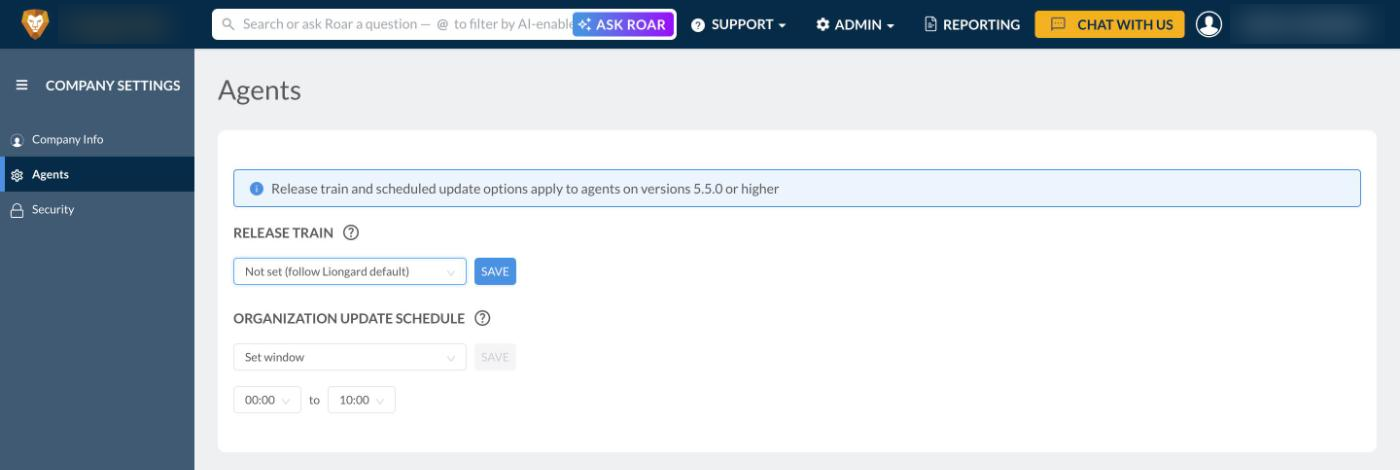
Company Settings > Agents, with Release Train set to "Not set" and an organization update window.
Things to know about update windows:
Each agent uses its own local clock. A 02:00 to 04:00 window means 2 AM to 4 AM wherever that machine is, so agents in different time zones update at different times.
A window has to fit inside one day. The end time must be later than the start time, so a window like 22:00 to 02:00 isn't allowed. Use something like 00:30 to 04:00 instead.
The start and end can't be the same time.
The agent checks the window before it downloads an update and again before it installs, so a slow download won't push the install outside the window.
Changing an organization default only affects agents that follow the organization. Agents with their own setting keep it.
Set options for a single agent (agent edit page)
Use the agent's own settings when one machine needs something different from the rest of the organization, like a lab agent on Early Access or a server that should only update overnight.
Permissions:Requires the Edit Agent permission. These options don't appear for On-Demand or Liongard-Managed agents.
- Go to Admin > Agents and open the agent.
- Under Release Train, pick an option:
- Default (Follow Organization): uses the organization's release train. This is the default.
- Early Access (EAP)
- Stable
- Long-Term Support (LTS)
- Under Update Schedule, pick an option:
- Follow organization default: uses the organization's window. The label shows the window, for example "Follow organization default (02:00 - 04:00)", or "(any time)" if the organization has no window. This is the default.
- Any time: this agent can update whenever an update is available. When the organization has a window, this option reads "Any time (ignore the organization default)".
- Set Window: pick a start and end time just for this agent. Same rules as the organization window.
- Click Save.
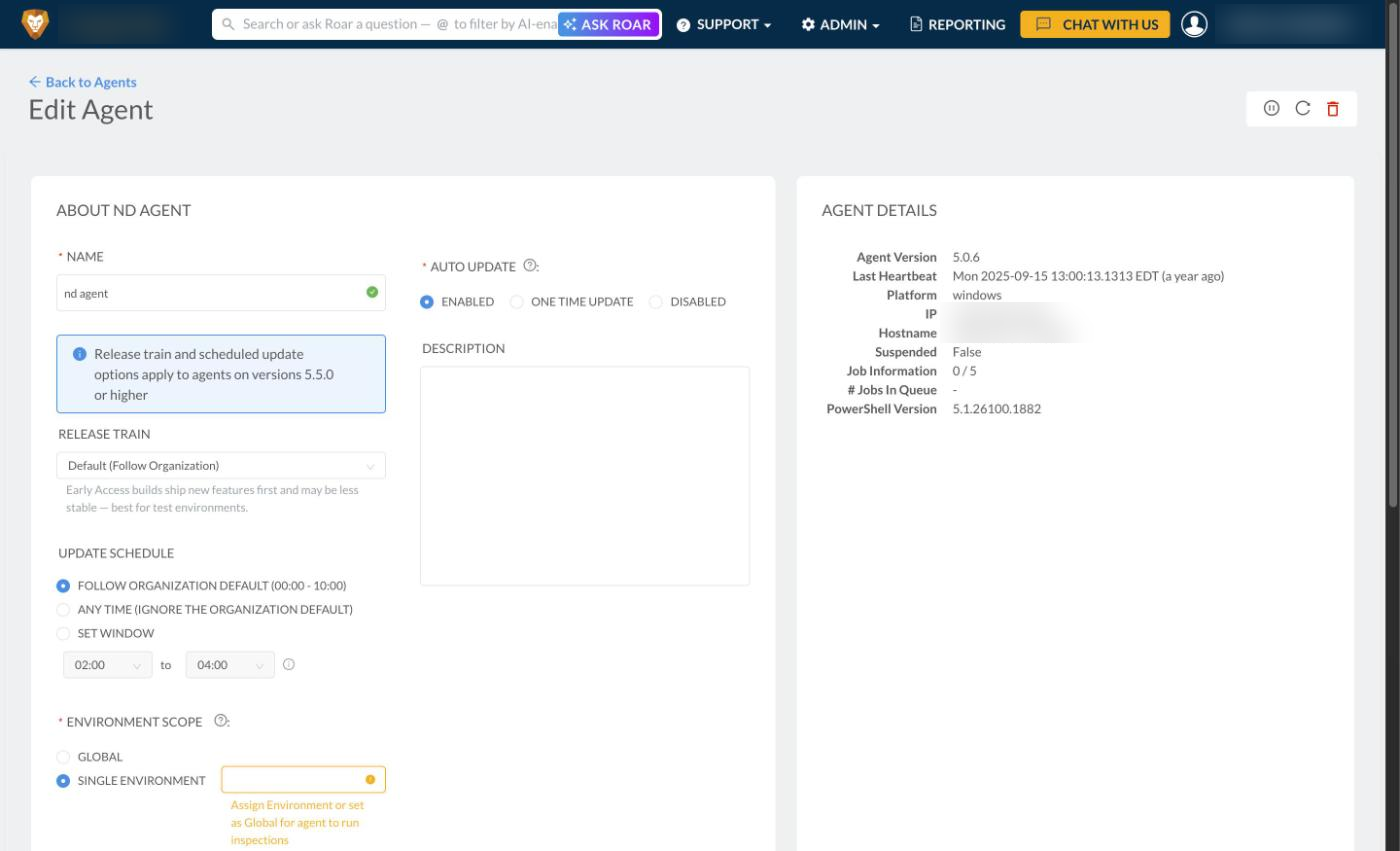
The agent edit page with Release Train, Update Schedule, and Auto Update.
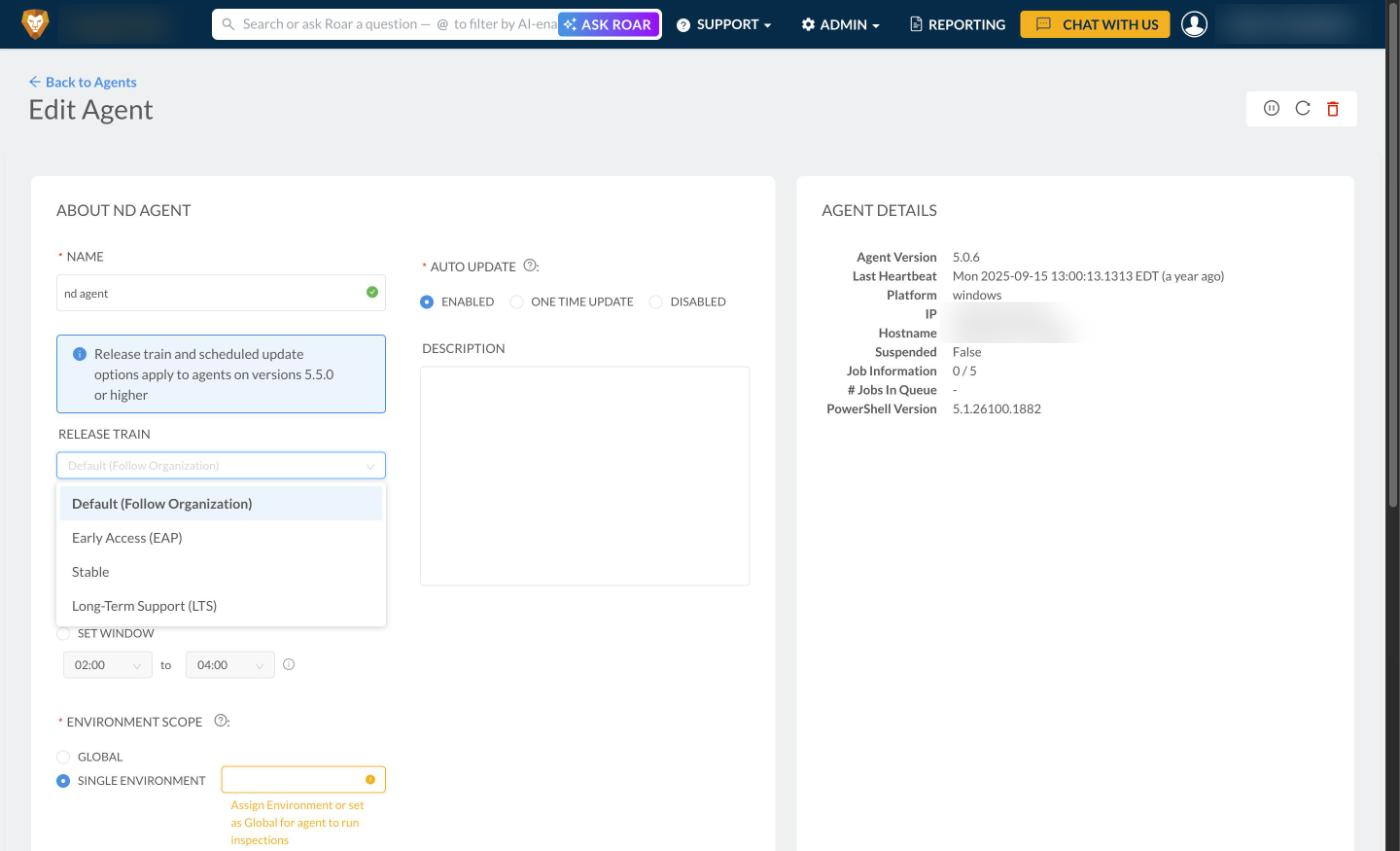
Release Train options on the agent edit page.
Hover over the window times to see them on the agent's clock and, if the agent has reported its time zone, the matching time for you.
Which setting wins
- Release train: the agent's setting, then the organization's, then the Liongard default (LTS).
- Update schedule: the agent's window or "Any time" choice, then the organization's window, then no restriction.
Auto Update
Auto Update on the agent page controls whether the agent updates at all:
- Enabled: the agent installs updates automatically.
- One Time Update: the agent installs the next update, then Auto Update switches to Disabled.
- Disabled: the agent doesn't install updates. It still reports its version, so it shows as outdated when a newer version is available.
Changing Auto Update requires the Global Admin or Global Environment Manager role.
Set the update schedule for several agents at once
- Go to Admin > Agents and select the agents.
- Click Actions > Set Update Schedule.
- Pick Follow organization default, Any time, or Set Window, then save.
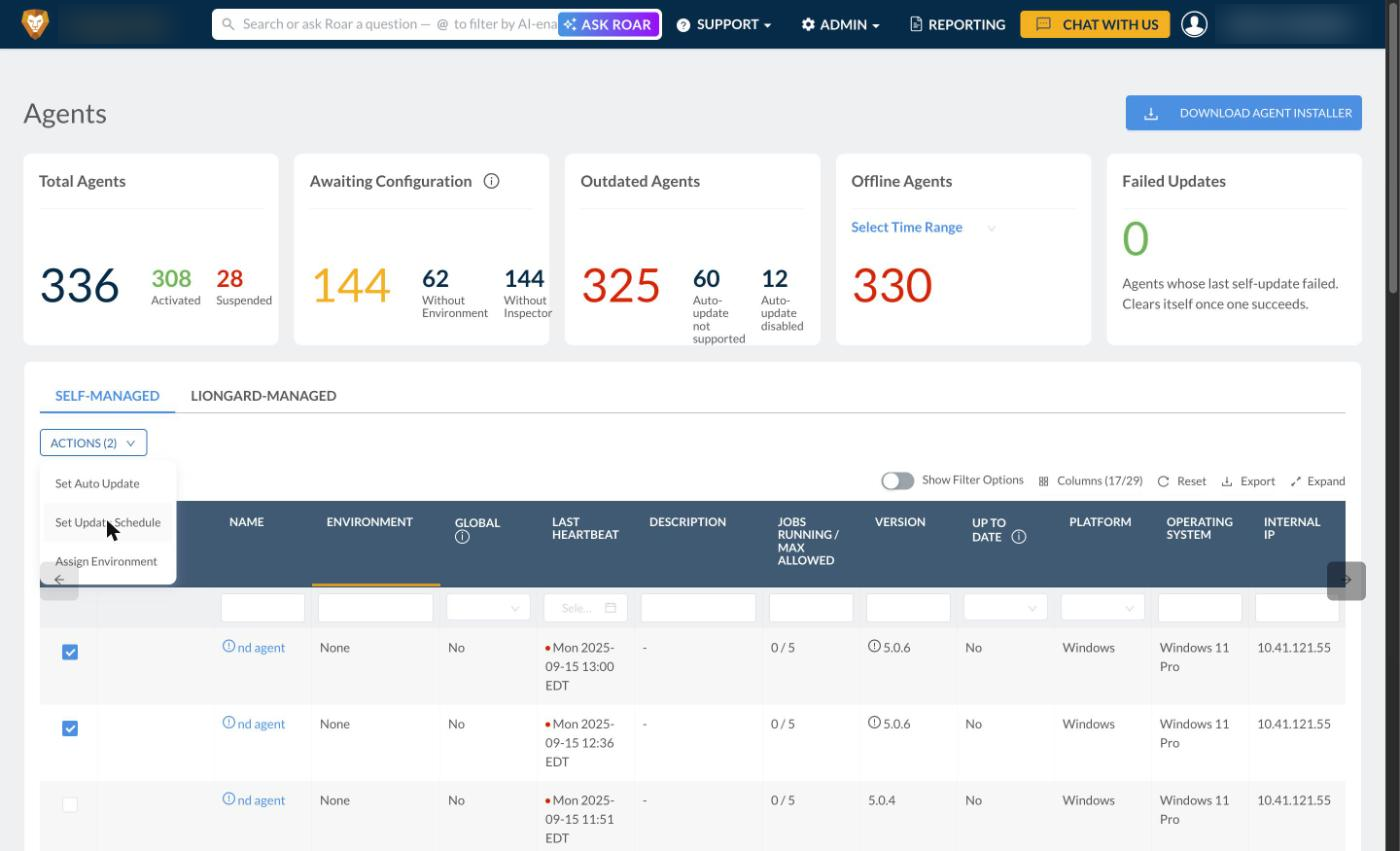
Actions > Set Update Schedule on the Agents list.
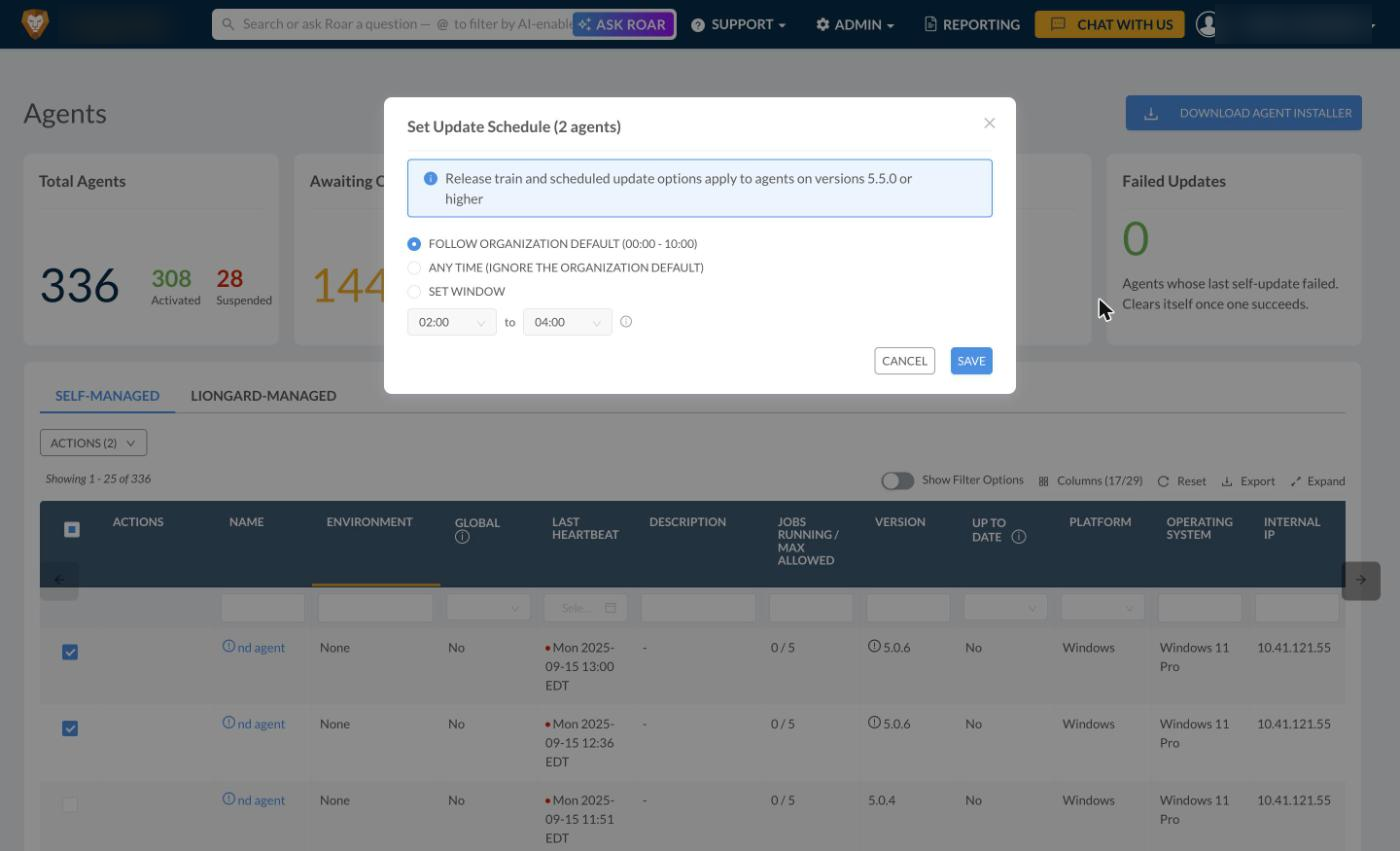
The Set Update Schedule window.
If the selected agents currently have different schedules, the window warns you before you overwrite them. There's no bulk action for release trains; set those per agent or at the organization level.
To see each agent's schedule in the list, turn on the Update Schedule column (hidden by default).
Monitor update health and FAQ
Monitor update health (Admin > Agents)
- Failed Updates tile: counts agents whose last self-update failed. It clears on its own once that agent updates successfully.
- Update Health column: shows OK or Update failed for each agent.
- Failure details: open the agent and click View More on the failure alert. You'll see the stage it failed at, the error, the number of attempts, the last attempt, the next retry, and the end of the installer log.
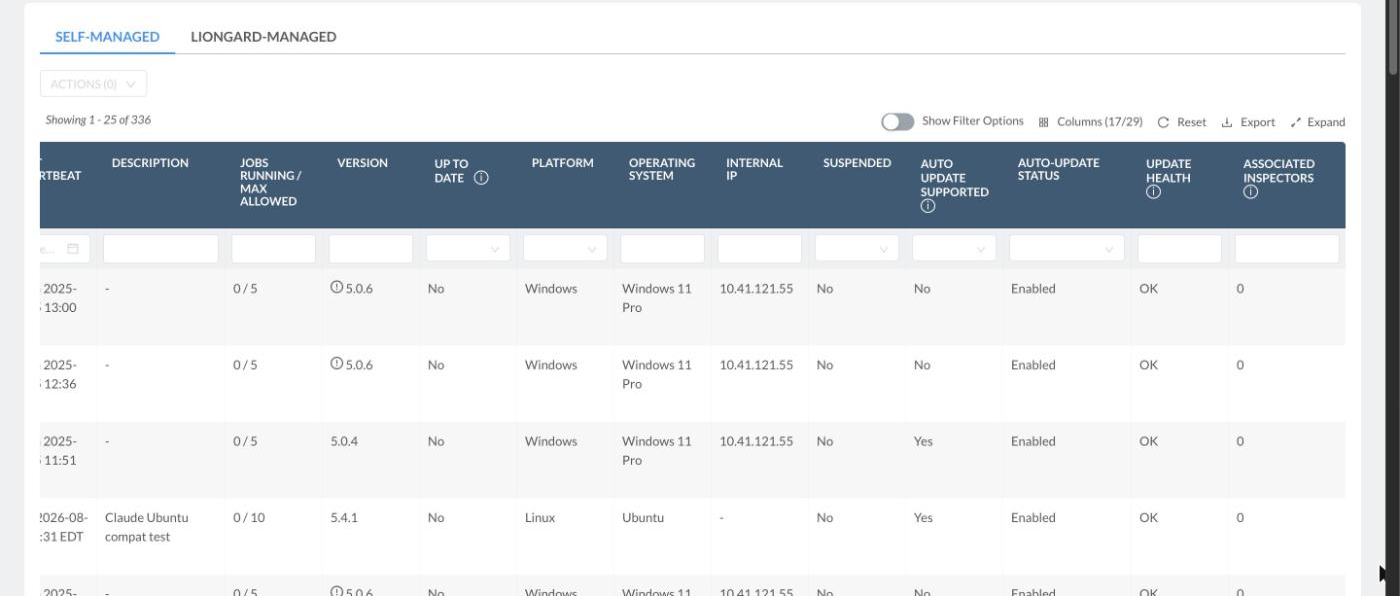
The Updated Health column in the Agents list.
Only agents on 5.5.0 or later can report failed updates. An agent on an older version that isn't updating shows up under Outdated Agents, not Failed Updates.
When an update fails, the agent keeps running its current version. It tries up to three times about 10 minutes apart, then once a day until it succeeds. Waiting for the update window or for running inspections doesn't count as a failed attempt.
FAQ
- An agent updated in the middle of the workday. Why? - Agents on 5.5.0+ check for updates every few minutes, not just at midnight. To control when updates install, set an update schedule in Company Settings > Agents or on the agent.
- Will an update interrupt a running inspection? - Usually not. The agent waits until no inspections are running. If inspections keep an update waiting for 24 hours with no update schedule set, or through two update windows in a row, the update goes ahead and interrupts the running inspection.
- I set a release train or update schedule, and nothing changed. - Check the agent's version. These settings only apply to agents on 5.5.0 or higher. Agents on 5.4.1 or earlier update through the legacy daily task and ignore both settings until they reach 5.5.0.
- I switched to Early Access, but my agents didn't update. - That's expected if there's no Early Access build newer than the version the agent already has. The agent always takes the highest version available to its train.
- I didn't pick a release train. What are my agents on? - Long-Term Support (LTS), the Liongard default.
- One agent is on a different train than the rest of my organization. - That agent has its own release train set. Open it and set Release Train back to Default (Follow Organization).
- How quickly do agents get a new version after it's released? - Usually within about 15 minutes, as long as Auto Update is on, no inspections are running, and the agent is inside its update window.
- Can I stop an agent from updating? - Yes. Set Auto Update to Disabled on the agent. It still reports its version so you can see it's outdated.
- Can I pin an agent to a specific version or roll one back? - No. Use Auto Update Disabled to hold an agent on its current version.
- Can I set a different release train per environment? - No. Release trains and update schedules are set at the organization level or per agent.
- What do I need to allow on my network? - Outbound HTTPS to
agents.static.liongard.com. The download uses the agent's proxy settings if one is configured. - How do I know the installer is legitimate? - The agent only downloads from
agents.static.liongard.comover HTTPS and verifies the file's checksum before running it. If the checksum doesn't match, the file is deleted, and the attempt fails. - Does the machine reboot during an update? - No. Only the Liongard Agent service restarts.
Legacy section and related articles
Agents on version 5.4.1 and earlier (legacy)
Agents on version 5.4.1 and earlier use a separate updater that checks for a new version once a day. Release trains and update schedules don't apply to these agents.
| Platform | Updater | When it checks |
|---|---|---|
| Windows | Scheduled task \Liongard\LiongardAgentUpdater | Daily, starting at midnight with a random delay of up to one day |
| Linux | liongard-agent-updater systemd timer | 60 seconds after boot, then every 24 hours |
| macOS | LaunchDaemon com.liongard.liongard-agent-updater | When it loads, then every 24 hours |
If a newer version is found, the updater downloads and installs it with no user action needed, as long as the service account used for the agent installation has administrative rights on the machine. If it doesn't, the Windows scheduled task reports a failed status.
These agents move to 5.5.0 through this same updater. No action is needed as long as Auto Update is Enabled or One Time Update; the updater task still exists, and the device is online when the check runs. Once an agent is on 5.5.0, the new update behavior described above takes over.
If an agent hasn't updated in a long time.On older versions, a failed install could remove the updater task. If the task is missing, the agent can't reach 5.5.0 on its own. Reinstall the agent using the MSI installer or follow Upgrade a Liongard Agent.
As of version 2.0.2, the Liongard Agent can auto-update itself. Installing Agent 2.0.2 or newer, and checking the auto-update box during installation will create a scheduled task on the server that will be set to check for a new version of the Liongard Agent at 12:00 AM daily.

If a newer version of the Agent is found, the server will download and update the Agent accordingly without any user interaction necessary, provided that the service account used for the Agent installation has administrative rights to the local machine.
If the service account does not have the necessary rights to complete the installation, the scheduled task will report a failed status.
Agent Name Change
Starting with version 2.0.2, the Liongard Agent MSI package was renamed to "LiongardAgent-lts" as part of our new brand messaging.
Deployment scripts using the old naming conventions (RoarAgent.msi, ROARURL, ROARACCESSKEY, etc.) will still work if necessary, but we do recommend updating the scripts when possible to ensure consistency across the platform.
New installations using the MSI will change the Windows service name to "Liongard Agent." Upgrading an existing installation will leave the service name as "Roar Agent."
Deployment Options
Reboot MessageWhen deploying via MSI, you may get a message saying that a reboot is necessary. That message can be safely ignored, and the installation should complete successfully after clicking OK.
To upgrade an existing Agent, follow the instructions found here.
To install an Agent for the first time, follow the instructions found here.
Updated 3 days ago